
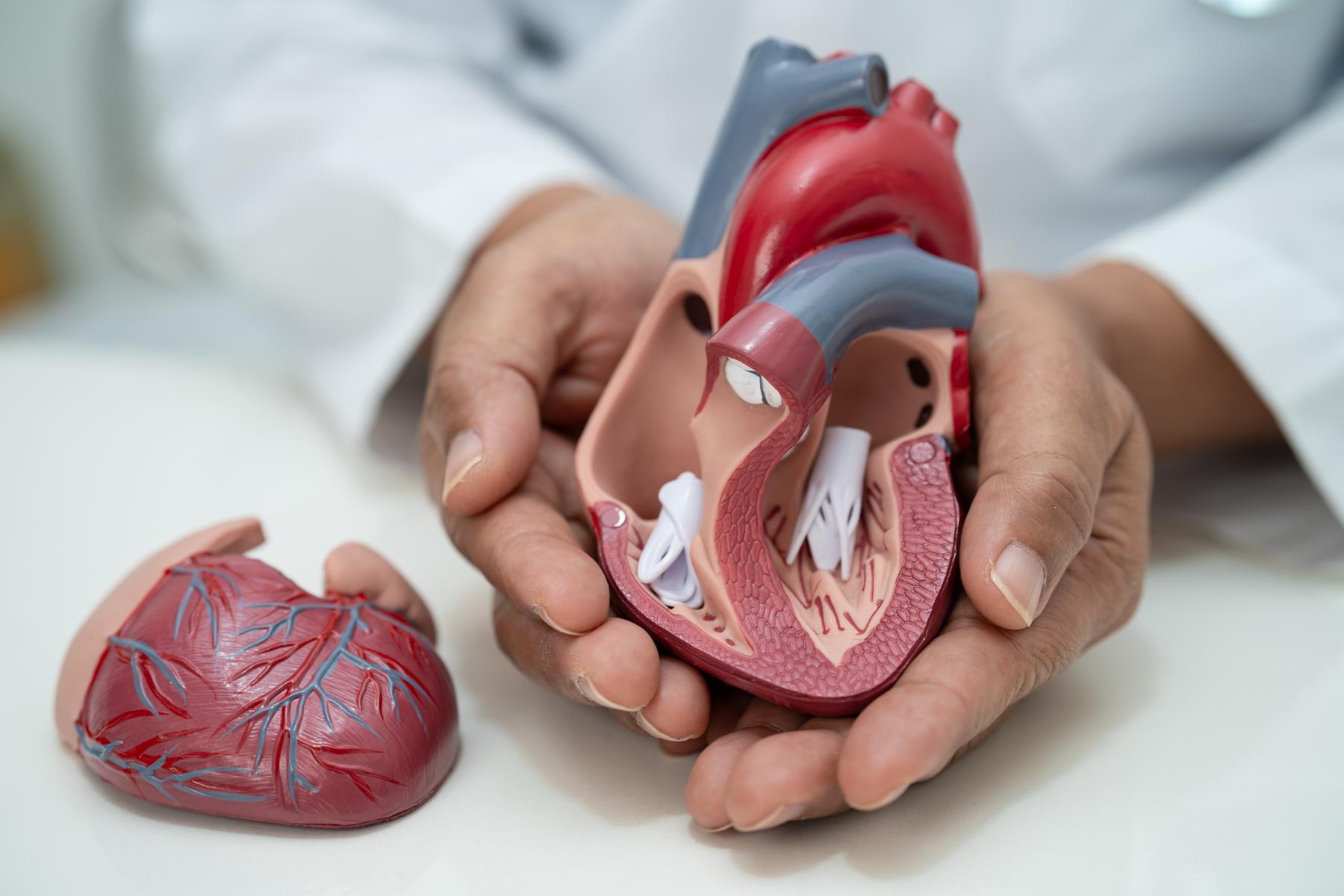
Ischemic heart disease is a condition that affects the blood vessels that supply the heart itself, known as the coronary arteries.
When these arteries become narrowed, blood flow through them decreases. As a result, the amount of oxygen delivered to the heart muscle is reduced. This condition is called ischemia, meaning that the heart muscle is not receiving enough oxygen.
The heart receives its blood supply through three main coronary arteries, which originate just at the beginning of the aorta (the large artery that carries blood from the heart to the rest of the body). Each of these arteries supplies blood and oxygen to a different area of the heart muscle. These arteries further branch into many smaller vessels, and therefore narrowing can occur either in the main arteries or in one of their branches.
When a narrowing develops in one of these arteries, the amount of blood reaching a specific region of the heart muscle decreases.
There are several possible causes for narrowing of the coronary arteries, but the most common one is atherosclerotic disease.
In this condition, an inflammatory process develops in the inner lining of the blood vessel. This inner layer is in direct contact with the blood flowing through the artery. Over time, cholesterol and other substances begin to accumulate in areas where inflammation occurs. Eventually, calcium deposits may also accumulate.
The combination of cholesterol, inflammatory cells, and calcium forms a deposit called an atherosclerotic plaque.
This plaque can cause narrowing of the artery at the site where it forms. In some cases, part of the plaque may rupture or detach. When this happens, fragments can travel with the bloodstream until they reach a narrower segment of the artery, where they may cause significant blockage.
Another, less common cause of coronary artery blockage is a blood clot that forms within the vessel due to various processes in the body.
The most common symptom of ischemic heart disease is chest pain.
The pain is often described as pressure, heaviness, or a burning sensation in the center of the chest. In many cases, the pain may radiate to other areas such as:
Sometimes the pain may also be accompanied by additional symptoms such as:
However, it is important to remember that not every episode of chest pain is caused by heart disease. There are many other possible causes of chest pain, and most people who experience chest discomfort do not have ischemic heart disease.

DR. Roy Rahpael, a specialist in Internal Medicine (Sheba Medical Center) and a graduate of the Etrogim Program
Not all cases of ischemic heart disease present as an acute cardiac event.
It is common to distinguish between two main conditions.
In this condition, symptoms usually occur during physical exertion, such as brisk walking, climbing stairs, or exercise.
When the patient stops the activity and rests, the pain usually subsides.
Acute cardiac events include several different conditions:
Unstable angina – chest pain that occurs even at rest or becomes increasingly frequent or severe.
Myocardial infarction without ECG changes – damage occurs to the heart muscle, but the electrocardiogram (ECG) does not show the typical changes. In such cases, blood tests reveal elevated levels of a protein called troponin, which is found inside heart muscle cells and is released into the bloodstream when these cells are damaged.
Myocardial infarction with ECG changes – in this situation, both elevated troponin levels and characteristic ECG changes are present.
The exact classification of the event depends on a combination of three factors:
Based on this classification, physicians determine how urgent the treatment should be and what type of treatment is required.
Several well-known risk factors contribute to the development of ischemic heart disease.
Controlling these risk factors is one of the most important components of treatment.
Sometimes risk factors can be managed through lifestyle changes alone, while in other cases medication or invasive treatment may also be required.
Lifestyle changes include:
It is also important to control other medical conditions such as high blood pressure, diabetes, and high cholesterol levels.
Treatment for ischemic heart disease may involve several components.
Prevention
Maintaining a healthy lifestyle over time is important both for individuals who have already been diagnosed with the disease and for those who are at risk of developing it.
The goal is to prevent disease progression and reduce the likelihood of future cardiac events.
Medication is mainly used to control underlying conditions such as:
In addition, some medications help reduce the risk of blood clot formation.
Cardiac catheterization is a medical procedure that allows doctors to visualize the coronary arteries with angiogram.
The procedure is performed through a small puncture in an artery in the wrist (radial artery) or in the groin (femoral artery). A thin catheter is advanced through the artery until it reaches the coronary arteries.
A contrast dye is injected through the catheter, and using advanced X-ray imaging, physicians can observe the flow of the dye through the coronary arteries. This allows them to identify areas where the arteries are narrowed.
If necessary, the narrowed artery can be widened using a balloon, and a stent can be inserted. A stent is a small metallic mesh that is expanded against the artery wall to keep the vessel open.
It is important to understand that the stent itself is only part of the treatment. Without addressing the underlying risk factors and making lifestyle changes, the stent can also become blocked in the future.
It is also essential to take the medications prescribed after stent implantation, as they help prevent the formation of blood clots within the stent.
In certain cases, particularly when the disease is more extensive or when another cardiac surgery is required (such as valve repair or replacement), coronary artery bypass surgery may be recommended.
During this procedure, arteries or veins taken from other parts of the body are used to create a new pathway for blood flow. The graft is connected before and after the blocked segment of the artery, allowing blood to bypass the narrowing.
Even after bypass surgery, atherosclerotic disease may develop over time in the graft vessels as well. Therefore, it remains essential to continue medical therapy and maintain a healthy lifestyle.
After a cardiac event, it is very important to gradually return to physical activity and adopt a healthy daily routine.
For this reason, structured cardiac rehabilitation programs are available. In these programs, patients perform supervised physical exercise and receive guidance on nutrition, lifestyle changes, and management of cardiovascular risk factors.


A condition in which the heart has difficult pumping blood efficiently. With proper medical follow-up and treatment, heart function can be improved and patients can continue maintaining an active daily routine.
Diseases that affect the heart valves, which are responsible for maintaining normal blood flow within the heart. In many cases, these conditions can be successfully diagnosed and treated with the help of advanced medical care.
Physical activity is important for heart health at every age. This field helps tailor safe and appropriate exercise for each individual — from athletes to beginners.
Heart health in women has unique characteristics and may sometimes present with less typical symptoms. Awareness, early diagnosis, and a healthy lifestyle can help with prevention and support long-term heart health.